Posted by ZERO Manufacturing on | Comments Off on Deep Drawn Aluminum: The Versatile Choice for Custom Enclosures
Deep-drawn aluminum enclosures offer a blend of lightweight strength and corrosion resistance, making them a reliable choice for a range of applications. Their design flexibility means they can be customized to meet specific requirements, ensuring an optimal fit for various technologies.
These enclosures are particularly well-suited for use in industries such as electronics, where protecting sensitive components is crucial. They are also used in aerospace for weight reduction, in medical settings for reliable performance, and in different industrial systems.
Benefits of Aluminum
Aluminum provides numerous advantages when used in enclosures. The material naturally resists corrosion, even in outdoor environments or applications involving exposure to chemicals or moisture. It also offers high thermal and electrical conductivity, making it suitable for enclosures that house electronic or heat-sensitive components. Housings for diagnostic equipment, surgical instruments, and battery enclosures for medical devices all benefit from aluminum’s high-quality surface finish and ease of sterilization.
Deep drawing further enhances aluminum’s advantages by creating seamless enclosures that are stronger and less prone to failure. It also supports efficient manufacturing at both low and high volumes, reducing material waste and overall production costs.
Customization Options
Design flexibility is one of the major advantages of deep-drawn aluminum. The process can achieve a wide variety of shapes, including cylinders, boxes, and complex forms that would be difficult to produce using other methods. This includes specialized housings for electronic devices that allow for heat dissipation, as well as custom components for aircraft and satellite systems requiring precise manufacturing and a high strength-to-weight ratio.
Finishing services such as powder coating and custom piercings can also be utilized to meet both performance and visual requirements. Contact our team if you are in need of more specialized features to discuss these options further.
Design Considerations
Designing aluminum enclosures requires careful attention to technical specifications to enable optimal performance and durability. Deep drawing can enhance accuracy in dimensions, and using multiple draws allows for greater depth and complexity in part geometry.
Proper planning is important to prevent wrinkling or material thinning. You’ll want to consider factors such as:
The type of aluminum alloy
Material thickness
Part shape
Working with experienced engineering teams early in the process can help optimize designs for manufacturing and reduce tooling expenses.
Contact ZERO Manufacturing
Deep-drawn aluminum enclosures combine strength, lightweight construction, and corrosion resistance in a single, seamless form. These properties make them ideal for aerospace, electronics, medical, industrial manufacturing, and other sectors. Aluminum’s natural conductivity, formability, and durability enhance performance, while the deep drawing process ensures precision and structural integrity. With a wide range of customization options, engineers and designers can meet their technical and aesthetic requirements.
ZERO Manufacturing offers deep-drawn aluminum housings that meet exacting standards. Our extensive tooling library, finishing services, and technical expertise allow for fast turnaround and tailored solutions. You can visit our homepage to learn more about our capabilities.
For technical questions, you can contact our team directly. If you’re ready to move forward with a project or need pricing details, request a quote today.
Posted by ZERO Manufacturing on | Comments Off on Why Choose Custom Cases Over Off-the-Shelf Options?
Purchasing an off-the-shelf case can seem like the fastest and cheapest option. However, for many projects, a custom case can be the smarter investment. A purpose-built design is often more efficient, more protective, and more cost-effective than adapting a pre-made case to meet unique requirements. When you factor in the expense of retrofitting, lost time, and potential damage from inadequate protection, custom designs often save money in the long run. This is especially true for specialized products, larger quantities, or demanding environments.
Custom Cases vs. Off-the-Shelf Cases
Off-the-shelf carrying cases are designed for general use, which means they may include features you do not need and lack ones you do. While they can meet basic requirements, they can fall short in fit, protection, and durability. In contrast, custom cases are engineered to your product’s exact dimensions and needs, reducing waste and providing a better overall fit. This tailored approach can lower costs over the project’s life cycle by eliminating unnecessary modifications.
Advantages of Off-the-Shelf Cases
The primary benefit of off-the-shelf cases is affordability. Mass production keeps the unit price low, making them suitable for small budgets or those requiring a single case for inexpensive items. If your product matches standard dimensions and does not need advanced protection, an off-the-shelf option may be enough.
Advantages of Custom Carrying Cases
Custom designs deliver advantages that go beyond what pre-made cases can offer:
Designed around your product. Each case is built to fit your exact specifications, whether it is for delicate equipment, professional sales kits, or OEM applications. A well-designed custom case can improve presentation, organization, and user experience while providing a precise fit.
Durability.ZERO Manufacturing builds cases from high-strength materials such as deep-drawn aluminum and injection-molded polymers. These materials provide lasting protection against impact, vibration, and environmental exposure, making them suitable for applications ranging from controlled indoor use to rugged field conditions.
Custom hardware options and better security. From handles and hinges to wheels and closure types, you can choose the hardware that best meets your handling and security needs. This flexibility allows you to create a case that is both functional and secure for its intended use.
No modifications needed. Off-the-shelf cases often need adjustments such as cutting holes, adding foam inserts, or resizing compartments. These post-purchase changes can be costly and time-consuming. With a custom design, the case is ready from the start.
Scalability. Producing custom cases in larger quantities can significantly reduce the per-unit cost. For organizations anticipating growth, this can lead to a strong return on investment over time.
Wide material selection. Custom projects give you control over materials, from heavy-duty plastics to lightweight aluminum. This ensures your case has the right balance of weight, durability, and protection for your specific application.
Long-term value. Off-the-shelf cases may have a lower initial price but can lead to higher costs if they need frequent replacement or fail to protect equipment. A custom case is built for durability, functionality, and long-term protection, reducing the risk of damage and the need for ongoing modifications or upgrades.
Carrying Cases From ZERO Manufacturing
ZERO Manufacturing designs and produces custom containers in multiple styles to meet a range of needs.
GUARDIAN Injection Molded Cases and Accessories
The GUARDIAN by ZERO line offers a highly durable exterior with customizable interior protection. Interior options can include hardware mounting panels and custom foam solutions designed for the specific shape and requirements of your equipment. This combination provides a high level of protection and organization for a wide range of applications.
Centurion Elite Cases
Centurion Elite aluminum cases combine strength, lightweight construction, and a sleek profile. The deep-drawn shells feature distinctive styling beads and are available in two finishes: a clear anodized option that highlights the natural aluminum surface or a textured black powder coat for a refined look. These cases offer lasting durability while maintaining a professional appearance.
Centurion Polaris Watertight Cases
Centurion Polaris cases provide lightweight yet rugged protection with watertight closures to safeguard contents from moisture and environmental damage. The deep-drawn, heat-treated aluminum shells have wrinkle-free surfaces accented by styling beads, combining strength with a polished finish. Multiple heights, closure types, and panel mounting flange options are available to meet a range of application needs.
Partner With ZERO Manufacturing
ZERO Manufacturing specializes in high-quality custom protective containers, including deep-drawn aluminum and polypropylene molded cases, enclosures, and assemblies. Serving industries such as aerospace, industrial, medical, oil and gas, logistics, electronics, and telecommunications, ZERO delivers protection that supports both performance and presentation.
Clients can choose from standard models, customize an existing product, or engineer a fully original case from scratch. With decades of expertise and a range of value-added services, ZERO ensures every case is built to protect valuable equipment and meet precise requirements.
Posted by ZERO Manufacturing on | Comments Off on Selecting the Perfect Custom Case
From aerospace and military cases to medical device and tech enclosures, choosing the right custom case for your application is essential for optimally protecting valuable equipment. Whether you’re shipping sensitive electronics, storing mission-critical tools, or carrying specialized gear, your case needs to withstand the demands of its environment and usage. In this blog, we’ll explore some factors to consider in selecting the perfect custom case for your needs.
Types of Cases
Cases are available in such types as:
Rackmount Cases. Ideal for electronic equipment such as servers, AV gear, and networking devices, rackmount cases are built to standard rack unit sizes and often include built-in mounting systems. These cases may feature louvers or perforated panels for ventilation and shock-absorbing materials that protect delicate electronics during transport.
Shipping Cases. Shipping cases are typically constructed from molded plastic or aluminum. They’re designed to endure rough handling and long hauls. These cases are often customized with foam padding or vibration-dampening materials to shield contents from impact and shocks. A wide range of sizes and configurations is available for safely transporting different types of equipment across long distances.
Storage Cases. These provide long-term protection for storing products, tools, and equipment. These cases may be stackable for efficient use of space and come with features like locking mechanisms, pressure-release valves, and custom foam interiors. They’re a reliable choice for environments where secure, organized storage is critical.
Material Considerations
You can select from materials such as the following for custom cases:
Plastic. Polyethylene and polypropylene are commonly used plastics for custom containers. They offer excellent impact resistance, are lightweight, and hold up well against UV rays and moisture — key features of outdoor applications. Plastic cases are versatile, durable, and economical, making them a go-to material for many industries.
Aluminum. Known for its impressive strength-to-weight ratio, aluminum is preferred when rugged performance is necessary. It’s corrosion resistant and easy to clean, making it ideal for high-use applications. Aluminum cases can also be powder-coated in various finishes to align with your brand aesthetics or functional needs.
Rigid Foam. The interior of a case is just as important as the exterior. Rigid foams, such as closed-cell polyethylene and polyurethane, offer superior cushioning and protection for delicate or high-value items. These foams are custom-cut to your equipment for a snug and secure fit during transport or storage.
Environmental Protection
To keep the contents of your case safe, you can customize your case with environmental protection features like:
Foam Inserts. Custom-cut foam inserts hold and secure gear so that it remains stationary. Whether transporting scientific instruments or sensitive electronics, foam inserts help absorb shocks and prevent internal movement. Case manufacturers can tailor the dimensions, density, and firmness of these inserts to meet the specific protection needs of your equipment.
Locking Mechanisms. Security is key when transporting or storing high-value equipment. Carrying cases can include various locking options such as combination locks, keyed latches, and tamper-evident seals that help prevent unauthorized access and ensure stored equipment remains safe.
Custom Cases at ZERO Manufacturing
From military-grade carrying cases to industry-specific storage containers, ZERO Manufacturing offers precision-engineered products tailored to your exact requirements. With decades of experience producing high-performance cases and enclosures, we specialize in both deep-drawn and fabricated aluminum cases and custom plastic solutions.
Whether you’re safeguarding electronics in a rackmount setup or transporting delicate instruments in a rugged shipping case, our team can design and deliver the perfect case and product features for your needs. We’ll work within your timeline and budget to maximize equipment protection in your operations.
Ready to design your custom case? Request a quote today and discover how the team at ZERO can help build the perfect protective solution for your gear.
Posted by ZERO Manufacturing on | Comments Off on Custom Shipping Cases & Containers
Customizing shipping cases and containers are critical for a range of applications, allowing customers to adapt to specific storage needs, mobility requirements, safety considerations, and other variables. As a global manufacturer and supplier, ZERO Manufacturing specializes in custom shipping cases and container solutions engineered to exact specifications. This blog post will explore the range of tailored solutions we can deliver, possible material choices, and common industry applications.
Customization Options
Shipping cases and containers can be designed to precisely fit the specific sizes and types of items being transported, with customization options that include:
Wheels and rollers
Hoist/tie-down rings
Foam inserts
Hardware
Humidity indicators
Integrated impact/vibration protection
Desiccant housing
Access ports
Electrical grounding
Rapid decompression
ZERO Manufacturing works closely with clients to balance functional and aesthetic considerations to increase organization, efficiency, and security in shipping and storage. We can deliver various types of storage cases for unique access requirements, including top opening, pallet and shroud, split, and double-ended carrying cases/containers.
Material Choices
The type of contents being stored and your shipping and handling requirements are the primary factors affecting which materials are suitable for your custom containers. We have a broad range of material choices that can be used for our custom carrying cases. These include:
Plastic. Polyethylene is a popular choice for custom storage cases, given its lightweight strength. It’s also resistant to impacts, moisture, and UV radiation, making it suitable for heavy-duty military cases or similar applications.
Aluminum. For applications requiring heavier impact resistance, aluminum provides an even greater strength-to-weight ratio along with resistance to most types of corrosion and contaminants. Aluminum is also very easy to clean and requires little maintenance.
Foam. Integrated foam vastly improves protection for delicate products, including sensitive electronics and scientific instruments. We often utilize a type of closed-cell foam made of polyurethane or polyethylene, which vastly improves durability with minimal weight gain.
In addition, a number of finishing options can be used to enhance performance and aesthetics, along with custom colors and graphics.
Industry Applications
Applications that can benefit from custom shipping cases and containers include various government agencies, public institutions, specialized service providers, and more.
Government Agencies
Many government facilities must safely store sensitive documents, ranging from citizen data to historical records. Even with mass digitization of documents, there remains massive volumes of paper records and other important recording mediums (such as audio archives, recovered military dog tags, etc.). Loss of such records is to the detriment of the public at large, prompting the U.S. National Archives to publish lists of stolen or missing historical records.
We’re proud to assist efforts at securing sensitive documents with custom containers and storage cases built to expand the capacity and longevity of government records. Our modular custom containers facilitate easy organization and removal of important records, which is especially critical during emergencies and natural disasters.
Public Service Providers
Public institutions (such as park services and fire departments) also rely on custom cases and containers. From large shipping containers to compact carrying cases and rack-mounted storage, public servants of all kinds can utilize custom cases to safely and easily transport important work products and materials. For instance, fire brigades and park rangers often use modified containers for mobile operations. Custom cases also help frontline workers of all kinds remain ready for a wide range of scenarios where essential items must be easily accessible and organized.
Shipping and Storage Containers at ZERO Manufacturing
From the heaviest-grade military cases to custom containers and storage cases, ZERO Manufacturing takes every use case scenario into account. Our modular custom storage containers have supported the shipping, storage, and retrieval needs for clients serving sectors as broad as aerospace, oil and gas, medical, electronics manufacturers, and much more.
To learn more about our state-of-the-art fabrication capacities, request a quote and share your custom storage goals with our container fabrication specialists.
Posted by ZERO Manufacturing on | Comments Off on Key Benefits of the Deep Drawn Forming Process
Deep drawing is a metal forming process using a punch and die to create three-dimensional, round or rectangular, hollow part features and products from flat sheet metal. Deep drawn parts are defined as those in which the depth of the hollow exceeds the radius or length and width of the flat blank shape. Parts are designed so that the thickness of the material is approximately uniform throughout after it is formed. ZERO Manufacturing specializes in deep drawn forming for durable, high-quality protective metal cases and enclosures.
There may be multiple ways to form cases and enclosures from sheet metal; however, the deep drawing process offers several benefits that result in a better product. Learn more below.
The Benefits of Deep Drawing
For many applications, deep drawing has many advantages for both the production process and the final product. Some of the key benefits of this method include:
High Production Speed
Deep drawing is fast because automated presses punch one blank after another with little time between cycles. Once tooling is set up, large quantities of parts can be drawn in rapid succession, for short lead times.
Enhanced Strength and Durability
Deep drawn metal goods are stronger than those produced through other methods because the stamping and drawing processes harden the metal, giving it better structural integrity. What’s more, drawn parts do not have seams, so they are made from contiguous material and have few weak points. This is ideal for deep drawn containers that will carry fluid, cases that must withstand impact, and aerospace components that will face heavy stress.
Cost Efficiency
Deep drawing is cost-effective for high-volume orders and standard shapes. Once the initial tooling is complete, goods are produced with less labor than other types of sheet metal manufacturing. Because goods are made from blanks that are accurately pre-sized, there is also very little waste. The speed of production further streamlines costs.
Precision and Consistency
Deep drawn parts are formed with specialized tooling that is designed for the application, so the resulting parts are highly accurate. And because the same tooling is used over and over, and the metal blanks are aligned in an automated press, there is very little variation from part to part and minimal scrap. Tooling is manufactured with the aid of computer modeling and precision machining, so it’s possible to achieve the dimensions specified on the part print to within tiny fractions of an inch. This ability to hold tight tolerances throughout a production run means part fit and function are improved.
Complex Geometries
Drawn parts are complex shapes with specific diameters, radii, and curvatures. The deep drawing process and specialized tooling create these shapes with great precision and uniform material thicknesses from a single piece of material. This means there is no welding or assembly to create the hollow feature, and fewer potential points of weakness or failure.
Excellent Surface Finish
The deep drawing process creates smooth surfaces because the press and dies form the metal with high precision. This means there are no jagged edges from cutting, no seams from joins, and no uneven spots from hammering. Components leave the press with a smooth surface that often does not require further finishing, aside from protective coatings or markings.
Reduction in Material Waste
Deep drawn metal forming minimizes waste because each blank is sized correctly to produce a hollow shape that is a consistent thickness. By starting with just the right volume of material, the finished piece will have no gaps or thin spots, and the precision tooling forms each blank the exact same way. As a result, there is little variation between pieces and from the specified dimensions and tolerances, and few pieces that need to be scrapped or reworked. This cuts down on waste and improves sustainability in manufacturing.
Deep Drawing Applications
ZERO Manufacturing serves multiple industries that use solid-construction cases, enclosures, and containers for protecting sensitive equipment, transporting materials and goods, and for storage. Some examples include, but are not limited to:
Logistics
Protective cases and enclosures are designed to contain tools, products, equipment, and other important items during transportation. Our products improve security and reduce the risk of damage or disorganization between the points of origin and destination.
Oil & Gas Industry
Our deep-drawn cans and enclosures provide protection for sensitive equipment and tools in the harshest conditions, like exposure to wind, rain, extreme temperatures, shock and vibration, and UV radiation. Rugged designs keep equipment enclosed and protected from damage in a variety of drilling and refining applications.
Automotive Industry
We offer large-scale production capabilities for high-precision automotive components like:
Body panels
Exhaust systems
Fenders
Fuel tanks
Oil pans
Structural parts
Electronics
Deep drawing is useful in many electronics applications, including cases for transportation, transformer shells, EMI shields, and enclosures for monitoring equipment.
Aerospace Industry
Deep drawn items commonly used in aerospace applications are protective yet lightweight. Examples include electronic enclosures and junction boxes, flight line cases, and airline rotable containers.
Medical Industry
Medical cases, containers, and enclosures must be robust and easy to clean. Deep drawing is useful for products like heart monitor and instrument cases, sterilization trays, transport cases for medicine and equipment, and more.
Packaging and Consumer Goods Industry
In the consumer goods market, deep drawn goods include aerosol containers for cleaners, lighting fixtures, furniture components, and more. The packaging industry also uses deep drawn containers for beverages and food.
Deep Drawing Services From ZERO Manufacturing
ZERO Manufacturing is an experienced provider of deep drawn components and products focused on high-quality production and excellent customer service. Our capabilities include aluminum deep drawing and sheet aluminum fabrication, rotational molding of polyethylene, laser cutting, design and engineering support, prototyping, tooling design and fabrication, welding, finishing (e.g., powder coating, anodizing, silkscreening), bagging, and assembly. We are ISO 9001:2015 and AS9001D certified and comply with FCC, CE, RoHS, and MFI requirements.
Posted by ZERO Manufacturing on | Comments Off on Every Deep Drawn Breath: Unveiling Deep Drawn Secrets
Effective for creating hollow parts with depths that exceed their diameters, widths, and lengths, deep drawn is a versatile metal forming technique for fast and repeatable production. It successfully forms seamless parts with unique geometries and intricate details, and can generate components with a good strength-to-weight ratio. Read on to learn more about this transformative production technique, compatible materials for the process, and how deep drawn supports applications in multiple industries.
Deep Drawn Process
To envision the end result of deep drawing, consider the shape and dimensions of a round, square, rectangular, or arinc metal cup. The end product is a hollow vessel that’s deeper than it is wide, making it a compatible project for this metal forming technique. Manufacturers can easily draw a simple cup shape utilizing a specific size blank; the blank is the key to the desired shape of the final drawn size. This ratio for deep drawn has been used for 70 years or more to determine the necessary size for successfully drawing a part from aluminum sheets with material retention.
Whatever shape a manufacturer needs to achieve, the deep drawn process utilizes a punch for mechanical action and compressive force to draw a blank of sheet metal over a die for shaping. Manufacturers will start by positioning a punch and die on a Hydro press, after which the metal sheet can be placed on top of the die. The press will drive the sheet over the punch, forcing the metal over the die/punch where it deforms and takes the die’s shape. Depending on the required part depth, the draw process may require a single stroke of the punch, multiple draws, or re-strikes.
Materials Utilized in Deep Drawn
Deep drawn is compatible with a wide range of metals and alloys, with common options including:
Aluminum alloys
Brass
Cold rolled low carbon sheet steel
Copper and copper alloys
Stainless steel (certain varieties)
The technique can create parts with complex shapes from these materials; however, it’s most appropriate for generating rectangles, cylinders, or other axisymmetric configurations.
Industries Served
Deep drawn is a versatile process, lending it to applications across a wide range of industries.
Automotive
The automotive sector requires high volumes of durable components that can withstand frequent, rugged use without breaking or degrading. Deep drawn can produce quality metal parts the industry can trust to perform reliably, with a reduced risk of leakage or part failure. The efficient process can also handle the capacity the industry needs, and at an economical price. Automotive manufacturers have the ability to complete several complex processes on a single machine to streamline operations.
Medical
Medical manufacturers turn to deep drawn not just for its precision but also for its cost-effectiveness. Compared to traditional machined components, deep drawn parts require less labor to produce and the process has high-volume capabilities for increased part yield. In the medical sector, this process is ideal for manufacturing everything from metal drug delivery and surgical devices to active implants and ultra-miniature components.
Aerospace
Safe and precise parts with a good strength-to-weight ratio are important for aerospace applications. With deep drawn, manufacturers can produce reliable, accurate parts from materials like aluminum, stainless steel, and CRS. The industry also adheres to multiple quality and safety standards, and the deep drawn process can effectively create compliant parts per a customer’s exact specifications.
Consumer Goods
In addition to more industrial goods, deep drawn is a common choice for producing numerous residential and consumer products, such as:
Baking pans
Casings
Plumbing fixtures
Kitchen sinks
Soda cans
Deep Drawn Solutions by ZERO Manufacturing
Since our founding in 1952, ZERO Manufacturing has become a trusted name in protective enclosures, cases, and assemblies for a diverse client base around the world. We offer high-quality deep drawn as part of our core manufacturing services, creating custom products for markets such as automotive, medical, aerospace, consumer goods, and alternative energy.
Through our proprietary deep drawing process, the “ZERO Method,” we fabricate components with superior resistance to stress, cracks, tears, and corrosion. We can also assist you with deep drawn aluminum parts for applications involving EMI or RFI shielding, ESD/grounding, heat dissipation, and more. Contact us today to learn about our deep drawn capabilities and protective product solutions.
Posted by ZERO Manufacturing on | Comments Off on Deep Drawn Process: A Technical Dive into Precision Manufacturing
A highly specialized metal drawing process, deep drawing utilizes a punch and ring to transform a sheet metal blank into a shaped component through tensile and compressive force. Learn more about this method, additional forming techniques, and how finding an expert metal manufacturer can support your project.
How the Deep Drawn Process Works
After cleaning the blank metal sheet to eliminate any contaminants, this metal forming process begins with lubricating the sheet for friction reduction. The technique then draws the sheet over a punch on a mechanical press, causing the material to flow and stretch. Deep drawing deforms the metal until it achieves a workpiece in the necessary configuration and depth. Manufacturers will repeat the deep drawn method as needed until a part has taken the desired form.
Deep Drawn: Key Benefits and Considerations
Deep drawing rapidly produces large volumes of tight-tolerance parts in complex shapes, all without the need for assembly. As a highly accurate process, it generates strong, durable, repeatable components with minimal material waste.
Before proceeding with this process, however, you should first consider:
Measurements. Precision is critical to all measurements related to the process. The shape and size of the die, for example, must be per spec as these factors impact deep drawn metals’ flow. It’s best to simplify conditions for making accurate components that match your intended design and dimensions.
Material thickness. You’ll want to ensure that a component’s walls aren’t too thin, as that could reduce strength. That said, the walls of these products are typically thinner than their bases, but you can make any needed adjustments with post-process tooling.
Spacing. Be aware of the spacing between the blank and the post. If they’re too close, this results in thinning and less precise parts.
Draft and tapering. Be aware that the process does result in draft and tapering along a part’s top. Keep this in mind during part design and you can adjust for this eventuality.
Working with a manufacturer that has in-depth experience with the process will help ensure you achieve quality results.
Our Deep Drawn Materials and Capabilities
At ZERO Manufacturing, we specialize in quality metal manufacturing, with deep drawn as one of our core competencies. We’re a trusted premier metal supplier serving diverse industries like aerospace, electronics, industrial, logistics, medical, oil and gas, and telecommunications with quality materials and extensive forming services.
Materials
We work with flat materials like sheet metal to create products such as deep drawn containers. Our team typically uses Aluminum Association alloys with government designations for deep drawn products. However, as many materials are compatible with the process, we’re capable of drawing most materials by special order.
Modifications
Deep drawing often involves additional forming processes to complete components. Common examples include:
Coining. With pressure and a closed die, coining uses compressive force to squeeze the metal material until it conforms to the die with the desired shape or surface features.
Adding flanges, beads, and ribs. Incorporating these part features into a workpiece helps increase rigidity for added strength.
Bulging. Utilizing a punch on a tube, cup, or shell, bulging expands a component’s walls either symmetrically or asymmetrically.
Threading. Working with a wheel and arbor, die, or tap, this forming technique creates helical threads on a component.
Hole punching. Using standard, piercing, or extruding punches, this process cuts shaped holes into a drawn metal component.
Trimming. This cutting process removes scrap material from a part to further shape it.
Notching. The notching process generates cuts in a component’s edge to facilitate part attachment, location, or clearance.
Dimpling. Dimpling produces indents within a material to allow bolt or rivet heads to remain flush with the part surface when fully fastened.
Ironing. While creating a smooth surface finish, ironing decreases shell wall thickness in a localized area of a workpiece.
Marking. This process is useful for marking components with graphics as well as lettering or part numbers for identification purposes.
Embossing. This technique generates either raised or recessed indentations in the desired design on a workpiece without greatly altering its thickness.
To best suit the unique needs of your application, in-house customization is available on all of ZERO Manufacturing’s deep drawn aluminum products.
Custom Deep Drawn Solutions From ZERO Manufacturing
With ZERO, the deep drawn process offers a superior solution for creating diverse and durable metal components with precision. Our commitment to quality is at the heart of everything we do. Our ISO 9001:2015-certified quality management system (QMS) ensures that we achieve all established quality objectives, delivering parts like deep drawn cans and containers that match your specifications and exceed your expectations. Contact us to learn more about our capabilities, or request a quote today.
Posted by ZERO Manufacturing on | Comments Off on Storage Cases: The Art of Organization
Industry professionals acknowledge storage cases as essential for efficient organization, safeguarding belongings and maximizing space. They prioritize security measures to protect valuable assets while guaranteeing easy accessibility for increased productivity.
Selecting the ideal case can make all the difference in streamlining the workflow. This blog delves into the intricacies of designing and manufacturing storage cases for organizational excellence.
Common Types of Storage Cases
Here are the common types of storage cases together with their purpose and significance across different sectors:
Instrument Cases
Instrument cases are crafted from high-quality materials such as plastics and aluminum, and meticulously designed to protect delicate instruments from damage caused by mishandling. With foam inserts tailored to the precise dimensions of each device, they ensure maximum protection during transport and storage.
Shock Mount Cases
Featuring specialized inserts that absorb shocks, these cases offer an additional layer of protection against impacts during transit. Their robust construction and tight sealing to prevent water damage make them ideal for safeguarding sensitive equipment in harsh settings.
Waterproof Cases
Waterproof cases are built to withstand extreme weather conditions and boast airtight and dust-proof seals. Made from high-quality resins and equipped with rust-resistant hinges and latches, they ensure the safe transportation of valuable items, even in corrosive environments.
Computer Cases
Essential for protecting valuable equipment and data, hard-sided computer cases provide a secure environment for laptops and other devices. They offer compartments for accessories and documents and safeguard computers from impacts and shocks during transportation.
Gun Cases
Gun cases are essential for protecting firearms during transport. Featuring shock-resistant foam padding and secure compartments for ammunition and accessories, they provide peace of mind for gun owners.
Portfolio Cases
Portfolio cases offer durability and functionality, making them ideal for carrying and protecting artwork. Meanwhile, heavy-duty plastic shells and customizable handles provide a secure and stylish solution for artists and professionals.
Tool Cases
Versatile and durable tool cases are designed to organize and protect gears for various industries. Customizable configurations and sturdy polyethylene construction ensure that tools remain secure and accessible.
Factors To Consider in Designing Storage Cases
Here are the key design elements to consider in storage cases, including common security measures aimed at promoting functionality and durability:
Material and Durability
The choice of material impacts the durability of the storage case. Incorporating common security measures, including sturdy locks, guarantees the safety of stored items. Additionally, easy access is crucial, and this is achieved through features such as ergonomic handles and smooth-opening mechanisms.
Size and Capacity
Determining the right size and capacity guarantees sufficient storage without wasted space. Moreover, cases with built-in security features such as tamper-resistant locks improve protection. Designing cases with stackable abilities and modular components also improves organization.
Purpose and Usage
Understanding the intended purpose of storage cases guides the design process. Incorporating easy-to-use locking mechanisms and supported corners enhances security. Meanwhile, designing cases with removable panels and fold-out compartments improves versatility for different applications.
Handling and Protection of Products
Designing handles, padding, and moisture protection considers how the case will be handled and the level of protection needed. Incorporating built-in security features such as combination locks and tamper-proof seals guarantees protection. Moreover, designing cases with impact-resistant materials and shock-absorbing padding improves safety during handling and transport.
Dimensions and Style
Precise measurements guarantee a tailored fit and robust support for stored items. They integrate inherent security elements such as sturdy latches heightens protection. Meanwhile, seamless accessibility is also paramount — achieved through oversized zippers and quick-release buckles. Crafting cases with adaptable interiors and modifiable compartments improves organization.
Choose ZERO Manufacturing for Enhanced Storage Solutions Across Industries!
At ZERO Manufacturing, we recognize the importance of storage cases in diverse industries. Our dedication to crafting these solutions extends beyond merely maximizing storage space; we prioritize stringent security measures and effortless accessibility. You can rely on ZERO Manufacturing for top-tier storage solutions meticulously tailored to meet your unique requirements!
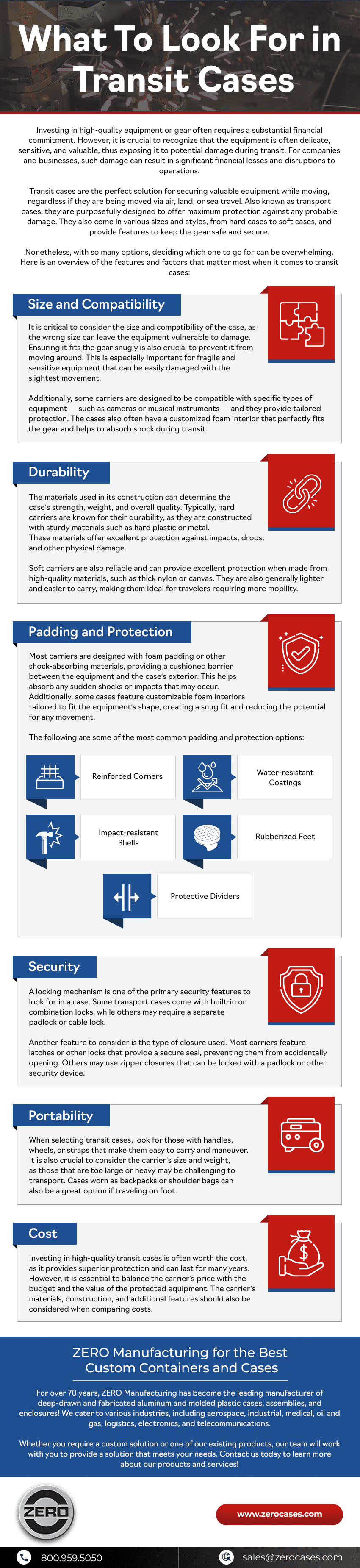
Posted by ZERO Manufacturing on | Comments Off on What To Look For in Transit Cases
Click to Expand
Investing in high-quality equipment or gear often requires a substantial financial commitment. However, it is crucial to recognize that the equipment is often delicate, sensitive, and valuable, thus exposing it to potential damage during transit. For companies and businesses, such damage can result in significant financial losses and disruptions to operations.
Transit cases are the perfect solution for securing valuable equipment while moving, regardless if they are being moved via air, land, or sea travel. Also known as transport cases, they are purposefully designed to offer maximum protection against any probable damage. They also come in various sizes and styles, from hard cases to soft cases, and provide features to keep the gear safe and secure.
Nonetheless, with so many options, deciding which one to go for can be overwhelming. Here is an overview of the features and factors that matter most when it comes to transit cases:
1. Size and Compatibility
It is critical to consider the size and compatibility of the case, as the wrong size can leave the equipment vulnerable to damage. Ensuring it fits the gear snugly is also crucial to prevent it from moving around. This is especially important for fragile and sensitive equipment that can be easily damaged with the slightest movement.
Additionally, some carriers are designed to be compatible with specific types of equipment — such as cameras or musical instruments — and they provide tailored protection. The cases also often have a customized foam interior that perfectly fits the gear and helps to absorb shock during transit.
2. Durability
The materials used in its construction can determine the case’s strength, weight, and overall quality. Typically, hard carriers are known for their durability, as they are constructed with sturdy materials such as hard plastic or metal. These materials offer excellent protection against impacts, drops, and other physical damage.
Soft carriers are also reliable and can provide excellent protection when made from high-quality materials, such as thick nylon or canvas. They are also generally lighter and easier to carry, making them ideal for travelers requiring more mobility.
3. Padding and Protection
Most carriers are designed with foam padding or other shock-absorbing materials, providing a cushioned barrier between the equipment and the case’s exterior. This helps absorb any sudden shocks or impacts that may occur. Additionally, some cases feature customizable foam interiors tailored to fit the equipment’s shape, creating a snug fit and reducing the potential for any movement.
The following are some of the most common padding and protection options:
Reinforced corners
Water-resistant coatings
Impact-resistant shells
Rubberized feet
Protective dividers
4. Security
A locking mechanism is one of the primary security features to look for in a case. Some transport cases come with built-in or combination locks, while others may require a separate padlock or cable lock.
Another feature to consider is the type of closure used. Most carriers feature latches or other locks that provide a secure seal, preventing them from accidentally opening. Others may use zipper closures that can be locked with a padlock or other security device.
5. Portability
When selecting transit cases, look for those with handles, wheels, or straps that make them easy to carry and maneuver. It is also crucial to consider the carrier’s size and weight, as those that are too large or heavy may be challenging to transport. Cases worn as backpacks or shoulder bags can also be a great option if traveling on foot.
6. Cost
Investing in high-quality transit cases is often worth the cost, as it provides superior protection and can last for many years. However, it is essential to balance the carrier’s price with the budget and the value of the protected equipment. The carrier’s materials, construction, and additional features should also be considered when comparing costs.
ZERO Manufacturing for the Best Custom Containers and Cases
For over 70 years, ZERO Manufacturing has become the leading manufacturer of deep-drawn and fabricated aluminum and molded plastic cases, assemblies, and enclosures! We cater to various industries, including aerospace, industrial, medical, oil and gas, logistics, electronics, and telecommunications.
Whether you require a custom solution or one of our existing products, our team will work with you to provide a solution that meets your needs. Contact us today to learn more about our products and services!
Posted by ZERO Manufacturing on | Comments Off on How To Find the Right Carrying Cases
Carrying cases are essential for transporting fragile or delicate products like electronics, cameras, tools, or other equipment. By researching and comparing different options, finding a case that offers the perfect balance of protection, functionality, and value is easy. However, selecting the right one can be challenging with so many products on the market.
There are several factors to consider before selecting the right one. These include size, weight, padding, material, features, and budget. In this article, we will discuss the key considerations in finding the right product to help ensure that all valuable products stay safe and secure.
Factors To Consider in Carrying Case Selection
Carrying cases come in all shapes and sizes, and finding the right one for specific applications can be tricky. Here are a few factors to consider before making a purchase:
1. Size and Weight
The case’s size should match the item’s size to carry. If it is too small, the item may not fit, while if it is too large, it may be bulky and difficult to transport.
The weight of the carrying case is also a crucial consideration, especially when planning to carry it over a long distance. An excessively heavy bag can be a burden and cause fatigue or strain on the user’s body. Conversely, a bag that is too light may not provide sufficient protection for the contents inside.
2. Padding
Padding is important when selecting a carrying case, particularly when transporting fragile or delicate items. The padding provides an extra layer of protection that can help absorb impacts and prevent damage to the contents inside. Moreover, the padding required will depend on the items’ fragility.
It is also worth considering the placement of the padding within the case. Some bags have padding on the exterior, while others place it on the interior lining. Bags with padding on the interior lining are typically more effective at protecting the contents from sudden impacts or movements.
3. Materials
Different materials are used to make carrying cases, each with advantages and disadvantages. For example, hard-shell products made of plastic or aluminum offer excellent protection but may be heavier than cases made of nylon or canvas. On the other hand, soft bags are usually lighter and more flexible, making them easier to carry. However, they may not offer as much protection against impacts.
4. Customization Options
Customization allows businesses to create a case design that perfectly meets their unique needs and preferences. Several options include lid stays, casters, color, and custom logos. These features can enhance the functionality and aesthetics of the case, making it easier to transport and use.
Lid stays are mechanisms that keep the case lid open, allowing easier access to the contents inside. Casters can make it more manageable to move the case around, especially for larger and heavier bags. Meanwhile, adding custom logos can help promote a business or brand, while color can provide a personal touch or match a company’s branding.
In addition to customization options, it is also important to consider factors like pressure, humidity, and aesthetics. Cases built to withstand extreme temperatures, moisture, or pressure can provide better protection for the contents inside. Aesthetics — including the look and feel of the case — can also impact its suitability for certain applications.
5. Additional Features
Additional features can add value and functionality to a case, making transporting items easier and more convenient. Some of the most common features include the following:
Compartments and pockets
Wheels and retractable handles
Shoulder straps
Locks and security features
Weather-resistant materials
Ventilation
6. Price
Different cases are available at all price points. Therefore, finding a bag that strikes the right balance between features and quality is important. One approach to accomplish this is to weigh the upfront cost of the product against the potential costs of replacing damaged equipment or repairing it. While investing in a high-quality case may come with a higher price tag, it can be worth it in the long run.
ZERO Manufacturing: The Leading Provider of Premium Custom Containers and Cases
If you are looking for a reliable and experienced provider of protective enclosure solutions, ZERO Manufacturing got you covered! With over 70 years of expertise, we are a recognized leader in producing high-quality deep-drawn and fabricated cases, assemblies, and enclosures for various industries. We can also create a custom case that meets your budget and schedule with the features you want to include.
Contact us today and let our team work with you to find the perfect protective enclosure solution for your unique needs!